
Frequently Asked Questions
Answers to the most common questions about the Goa residential training, the Sri Lanka season and the online training.
What is the Parimukti Somatic Facilitator Training?
A 12-day residential training in Goa, also live online over four weekends, where you learn to work with the body, breath and nervous system, first for yourself, then to guide others. You leave with practical facilitation skills. After completing the training requirements and practical assessment, you receive the Certified Parimukti Somatic Therapist certificate.
Do I need to be a yoga teacher, coach or therapist?
No. Many participants are, but beginners are welcome. You need curiosity, openness and a willingness to practise. Everything is taught step by step.
Can I really start facilitating after 12 days?
Yes, because you practise from day one. You experience every practice yourself, then guide partners and small groups with feedback. You graduate with lived experience, not just theory.
What is included in the Goa training?
The full 12-day curriculum and certification assessment, training manual and workbook, all practice materials, breakfast, lunch and dinner on all 12 days, mineral water, fresh coconuts, herbal teas and fruit, one spa treatment, a local excursion, ecstatic dance and sound healing evenings, an integration day, a business workshop on building your practice, opening and closing ceremonies, a welcome gift and lifelong alumni access. The venue is directly on the seafront in Arambol.
What is not included?
Flights and travel insurance. Airport transfers can be arranged on request (€25 each way from GOX or GOI). Extra spa treatments beyond the one included.
Where do I stay?
Two options, same training: a shared room on the training premises (two people per room), or a private room in a partner hotel a short walk away, subject to availability.
What does it cost?
Shared room €1,199. Private room €1,499. Prices already include a €100 discount for the first 5 confirmed bookings per cohort. The €300 reservation payment is part of the total, not an extra charge. See Dates and Prices for every cohort.
How do I book?
Send the application form. We check fit and availability with you, then your place is confirmed once the €300 reservation payment arrives. The balance is normally due seven days before the training.
What if my plans change?
The €300 deposit is not refundable, but in some situations it can be transferred to another person or a future Parimukti training, under the cancellation and transfer policy.
When are the next trainings?
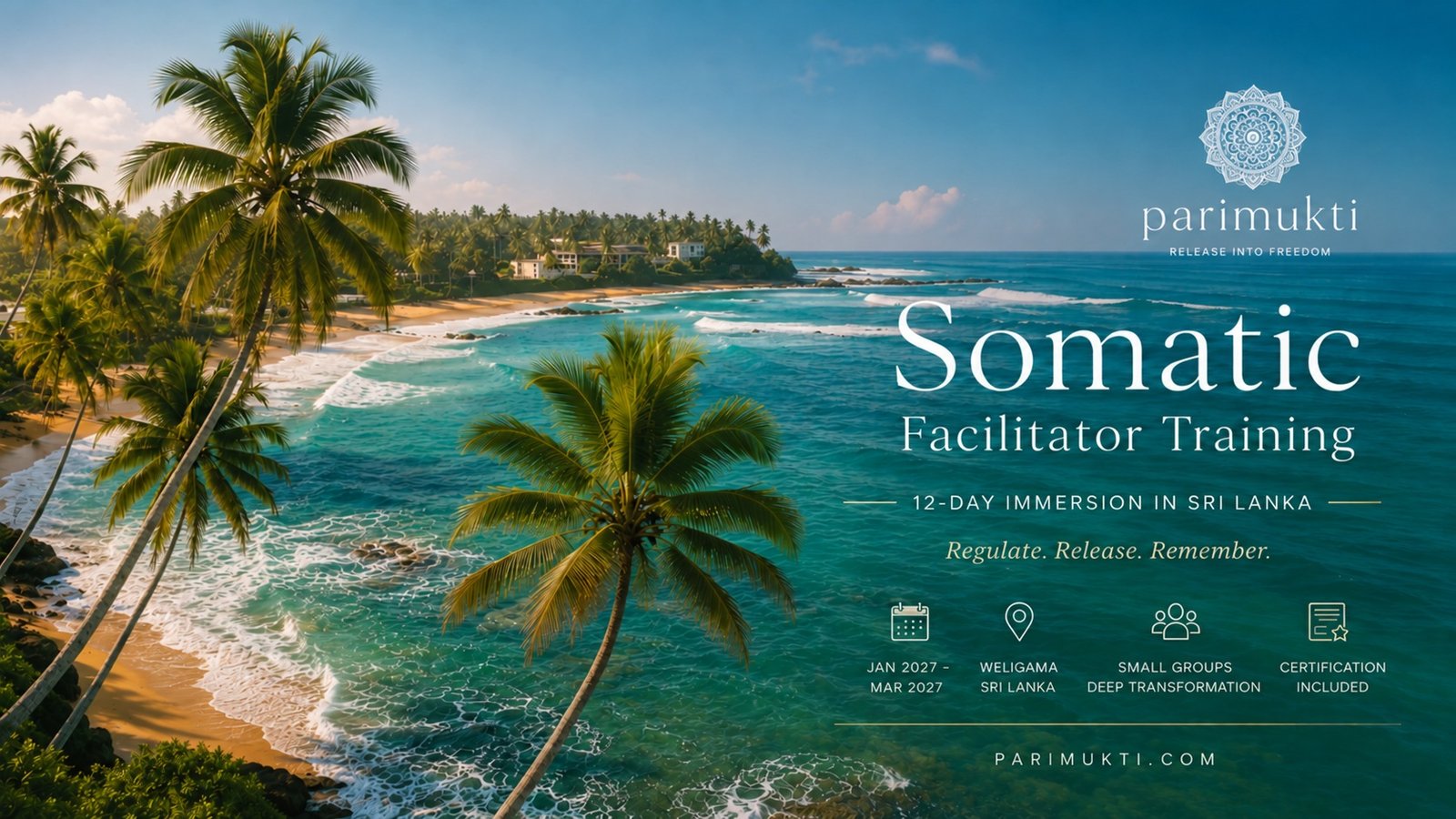
Goa: Nov 23 to Dec 4 2026, Dec 11 to 22 2026, Jan 3 to 14, Feb 3 to 14 and Mar 3 to 14 2027. Sri Lanka: a residential season from January to March 2027, exact dates confirmed during application. Online: a new cohort starts every month.
What is the online training like?
Four live weekends with an international cohort: guided practice, partner work and real feedback. No recordings to watch alone. After completing the training requirements and practical assessment, you receive the Certified Parimukti Somatic Therapist certificate.
Is this therapy?
No. This is professional education for facilitation, not therapy or a clinical licence.
What language is the training in?
English. German information pages are available at parimukti.com/de.
What if I find it emotionally difficult during the training?
That is normal and expected. Groups are small, every practice is an invitation, and you choose your own pace. The team supports you throughout, and you are never pressured to share.
Before you decide: questions people ask about somatic training
Understanding somatic work
What is somatic therapy?
Somatic therapy is a broad name for body-based approaches to wellbeing and change. Instead of working only through conversation, it includes physical sensation, breath, movement and posture in the process. The idea is simple: stress, emotion and experience show up in the body as much as in the mind, so the body is a direct way to work with them. It is an umbrella term covering many different methods and schools rather than one fixed technique.
How does somatic therapy work?
A practitioner guides your attention to what is happening in your body: sensations, impulses, breath, tension. By noticing and gently working with these, patterns of stress and holding can begin to shift. Sessions usually combine guided attention, simple movement or breathing practices, and time to integrate. Different methods emphasise different tools, but the shared principle is working with experience as it shows up in the body. Read the full guide.
What is Somatic Experiencing?
Somatic Experiencing (SE) is a specific, trademarked method developed by Dr Peter Levine and taught by Somatic Experiencing International. It works with trauma by tracking body sensations and supporting the nervous system to complete stress responses. SE is one of several well-known somatic approaches – it is not a generic term for all somatic work, and only SEI-licensed organisers offer SE training. Parimukti teaches its own somatic method, which is a different approach.
What is somatic healing?
“Somatic healing” is an informal umbrella phrase rather than a clinical title. People use it for body-based practices that help release stress, settle the nervous system and process emotion – through movement, breath, attention, and in some methods touch. It is not a medical treatment and not a replacement for medical or psychological care. Read the full guide.
What is a somatic facilitator?
A somatic facilitator is someone trained to guide others through body-based practices: grounding, movement, breathwork, awareness exercises. A facilitator is someone who creates and holds a learning space, not someone treating a medical condition. A course certificate is not a government licence: whether a title or service is regulated, and what qualifications, registration or insurance you need, depends on where you practise – check the local rules for the title and services you intend to offer. Good facilitator training includes supervised practice, honest feedback and a clear ethical scope. Read the step-by-step career guide.
What does a somatic therapist do?
A somatic therapist helps clients notice and work with the physical side of their experience: tension patterns, stress responses, blocked emotion. Sessions involve guided attention to sensation, movement, breath and, in some methods, touch. Where the title “therapist” is legally protected, practitioners need the relevant licence; elsewhere, similar work is offered under titles like facilitator, practitioner or coach. Read the step-by-step career guide.
What happens in a somatic therapy session?
A session usually starts with a check-in and a short settling practice. The practitioner then guides your attention to bodily sensations as you explore a theme, sometimes adding gentle movement, breath or postural work. You stay clothed, you set the pace, and you can pause or stop anything. Sessions close with a few quiet minutes to integrate. Read what a session looks like, step by step.
Trust and approach
Is somatic therapy legitimate?
Somatic work is a broad field: some methods are well established, others are newer. Body-based approaches have been used in clinical and educational settings for decades, and the best-known schools run structured multi-year trainings with professional standards. As in any growing field, quality depends on the method and the provider, so it is worth checking who trained the practitioner and what their training actually involved. Read what the evidence actually says.
Is somatic therapy evidence-based?
Partly, and the honest picture matters. Research is growing but still thin compared with established psychotherapies. The strongest single study so far is a 2017 randomised controlled trial of Somatic Experiencing for PTSD, which found significant symptom reduction; its authors also say more research is needed. Most other somatic methods rely on smaller studies and long clinical experience. Read what the evidence actually says.
Does somatic therapy work?
Many people report meaningful benefits, and early research is positive. But effects vary by person, method and practitioner, and the research base is still small. Be cautious of anyone promising guaranteed results. Somatic work is best seen as a complement to medical and psychological care, not a replacement for it. Read what the evidence actually says.
Does somatic therapy work online?
Surprisingly well, for many purposes. Guided attention, movement and breath practices translate naturally to video, and live online trainings can include real partner practice and feedback. Touch-based work is the main thing that does not transfer. If you learn somatic work online, choose a live interactive format over recorded-only courses. Read how online somatic training works.
What is the difference between somatic therapy and EMDR?
EMDR is a specific, protocol-based trauma therapy that uses bilateral stimulation, usually guided eye movements, and is practised by licensed clinicians. Somatic therapy is a broad family of body-based methods working with sensation, movement and breath. Both are used for trauma, but they are different tools, and some practitioners train in both. Read the full comparison.
How does somatic therapy differ from talk therapy?
Talk therapy works mainly through conversation, reflection and reframing. Somatic work adds a second channel: what is happening in the body right now. Many people find that talking alone does not reach stress that is held physically, and somatic practices offer a more direct route. The two combine well, and many therapists use both. Read the full comparison.
Becoming a practitioner
How do I become a somatic therapist?
Train with a school whose method and standards you trust. Paths range from short facilitator trainings of a few days to multi-year professional programmes. If you plan to use the title “therapist”, check whether it is regulated where you live – in many countries it requires a clinical licence. Facilitator, practitioner and coach titles are usually open to certified graduates. Read the step-by-step career guide.
How do I become a somatic practitioner?
Pick a method, complete a training that includes supervised practice and a real assessment, then work within its scope. Practitioner-level paths range from 12-day intensives to three-year programmes. The amount of guided, feedback-rich practice matters far more than the length of the brochure. Read the step-by-step career guide.
How do I become a somatic facilitator?
A facilitator certification is the most accessible entry: a shorter training that teaches you to guide practices safely and within a clear scope. Look for trainings where you practise guiding real people with feedback, not just watch lessons. Parimukti’s facilitator training runs as a 12-day residential in Goa and live online over four weekends. Read the step-by-step career guide.
How do I become a somatic coach?
Coaching is the least regulated path: complete a somatic coach or facilitator certification, define who you help and how, and stay within a non-clinical scope. Many coaches add somatic skills to an existing coaching practice rather than starting from zero. Read the step-by-step career guide.
How do I become a certified somatic therapist?
“Certified” means a school has assessed you against its own standard – there is no single global certifying body for somatic work. Choose a training with supervised practice and a clear assessment, and check what its certificate allows you to claim in your country. Read the step-by-step career guide.
Do I need a degree to become a somatic therapist?
For most somatic trainings, no. Facilitator and practitioner programmes welcome people from many backgrounds: yoga teachers, coaches, bodyworkers, complete career changers. A degree or clinical licence only becomes relevant for regulated titles or clinical settings – whether either applies depends on where you live, so check locally. Parimukti’s training has no degree requirement. Read the full guide to degrees, licences and certificates.
Do I need a licence to practise somatic therapy?
A course certificate is not a government licence: whether a title or service is regulated, and what qualifications, registration or insurance you need, depends on where you practise. Check the local rules for the title and services you intend to offer, and describe your work honestly. Read the full guide to degrees, licences and certificates.
Who can practise somatic therapy?
Almost anyone can train, but who may offer what depends on scope. Body-based facilitation and coaching are open to certified practitioners in most places. Clinical treatment of trauma or mental-health conditions belongs to licensed professionals. A good training teaches you exactly where your scope ends. Read the full guide to degrees, licences and certificates.
How long does it take to become a somatic therapist?
From 12 days to three years, depending on the path. Intensive facilitator certifications, like Parimukti’s 12-day residential, get you guiding basic sessions quickly. Comprehensive professional programmes such as Somatic Experiencing take about three years part-time. Most practitioners keep training and gathering supervised experience long after their first certificate. Read the full timeline guide.
How long does somatic therapy certification take?
It varies by school: weekend courses, 12-day intensives, four-weekend live online trainings and multi-year professional programmes all exist. What matters is what the certificate covers and how much supervised practice is included, not just the calendar length. Read the full timeline guide.
Choosing a training
What is somatic training?
Somatic training teaches you to work with body-based practices – first for yourself, then to guide others. A good training combines guided experience, supervised practice, feedback and a clear scope, not just a library of exercises. Read more about somatic training.
What is Somatic Experiencing training?
Somatic Experiencing training is the official professional programme of Somatic Experiencing International, leading to the SEP (Somatic Experiencing Practitioner) certificate. It runs in modules over about three years and includes personal sessions and case consultation. Only SEI and its licensed organisers offer it. Parimukti does not offer SE training; our facilitator training teaches the Parimukti Method, a different approach.
What is the best somatic therapy training?
There is no objective “best” – there is the best fit for your goal. Compare what the training qualifies you to do, how much live supervised practice it includes, group sizes, who teaches, and what graduates actually do afterwards. Be cautious of any school that cannot answer these plainly. Read how to choose the right training.
What are the best somatic certification programs?
Well-known names include Somatic Experiencing (multi-year, clinical focus), Sensorimotor Psychotherapy, Hakomi, and shorter facilitator certifications like Parimukti’s. The right choice depends on whether you want a clinical career, a facilitation practice, or skills to add to an existing profession. Compare scope, practice hours and cost rather than brand names. Read how to choose the right training.
Which somatic therapy trainings are accredited?
There is no central accrediting body for somatic work – certificates are issued by each school. Some programmes hold recognition with professional bodies or offer CE credits in specific countries; always verify that directly with the body named. Treat “accredited” as a starting question, not proof: accredited by whom, and what does it entitle you to do? Read how to choose the right training.
Can I take somatic therapy training online?
Yes. Live online trainings can work very well if they include real practice, partner work and feedback rather than recordings alone. Touch-based skills are the main thing that does not transfer online. Parimukti’s live online certification runs over four weekends, with a new international cohort every month. See the live online certification.
Where can I take somatic therapy training in person?
In-person trainings run worldwide, from city studios to residential immersions. Residential formats add something online cannot: full days, a group that lives the work together, and distance from your everyday routine. Parimukti’s residential training runs in Goa, India, with a Sri Lanka season from January 2027. See the Goa residential training.
What somatic training is available for therapists?
Many somatic schools welcome licensed clinicians, and some programmes are built specifically for them. For therapists, somatic methods add a body-based channel to existing clinical skills. If you need continuing-education recognition, check directly whether a training offers it in your jurisdiction. See training for trauma-informed practitioners.
What somatic training is available for yoga teachers?
Yoga teachers are among the most natural candidates: you already work with bodies, breath and attention. Somatic training adds nervous-system literacy, trauma-informed cueing and facilitation skills, which extend what you can offer – private sessions, workshops and retreats. Read our guide for yoga teachers.
Is there somatic training near me?
Somatic trainings run in most regions, and live online options remove geography from the question entirely. Parimukti runs residential trainings in Goa, India, a Sri Lanka season from January to March 2027, and a live online certification with a new international cohort every month. See the live online certification.
Where can I study somatic therapy in India?
India has a long tradition of body-mind training and hosts a growing number of somatic programmes, many in Goa and other wellness destinations. Parimukti’s 12-day residential Somatic Facilitator Training runs in Arambol, North Goa, directly on the beach, with monthly cohorts through the winter season. Read our guide to training in India.
Cost and career
How much does somatic therapy cost?
As a client, sessions are usually priced like other therapy or bodywork in your area. As a student, training ranges from a few hundred euros for short certifications to roughly ten thousand US dollars in tuition for a full multi-year professional programme. Parimukti’s live online certification is EUR 699-899; the 12-day Goa residential is EUR 1,199-1,499 including accommodation and all meals. See current dates and prices.
How much does Somatic Experiencing training cost?
Somatic Experiencing International publishes US tuition of about $1,130-1,650 per module, across eight modules over roughly three years, plus personal sessions and case consultation. Ireland’s SE programme lists total tuition of GBP 6,000-7,400. Facilitator-style certifications are generally shorter and far lower cost. Read the full cost comparison.
Is Somatic Experiencing training worth it?
If you want a clinical, trauma-focused career and can invest three years and a five-figure tuition, SE is the best-known structured path. If your goal is guiding sessions, groups or retreats, or adding somatic skills to yoga, coaching or bodywork, a shorter facilitator certification gets you practising much sooner for far less. “Worth it” depends entirely on what you want to do afterwards. Read our honest decision guide.
Are scholarships available for Somatic Experiencing training?
Some SE organisers offer reduced or pro bono fee levels – Ireland’s programme, for example, lists a lower fee in exchange for pro bono community hours. Parimukti does not run a formal scholarship programme, but the online training can be paid in three instalments, and we are happy to discuss payment options when you apply.
How much do somatic therapists make?
There is no reliable public salary data for somatic work. Most practitioners are self-employed, and income depends on location, format – private sessions, groups, retreats – and how well you build your practice. For many people, somatic skills work best added to an existing practice or as the base of a small facilitation business. Read how somatic practitioners actually earn.
What work can I get after somatic training?
Most somatic practitioners are self-employed: private sessions, small groups, workshops, retreats, online programmes. Some work within clinics, wellness centres, spas and retreat venues, often under titles like facilitator, practitioner, coach or bodyworker. Somatic skills also extend existing careers in yoga, massage, coaching and counselling. Read how somatic practitioners actually earn.
Still deciding? Ask us anything or send your application and we will figure out the fit together.