
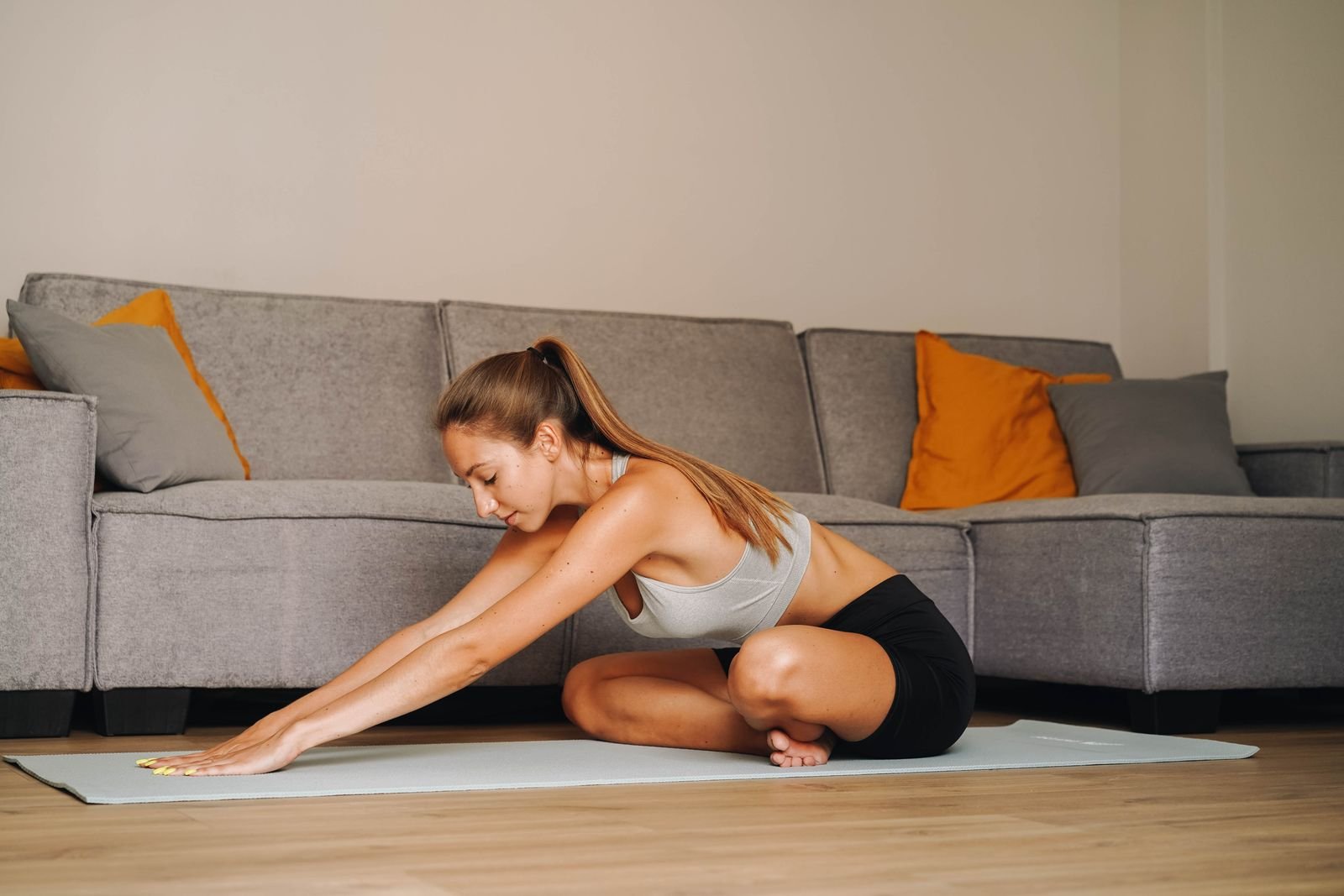

Stretching is one of the oldest self-care practices there is, and one of the most commonly done on autopilot: a quick pull, a bounce, a glance at the clock. A somatic approach is different mainly in where your attention is. These seven principles are about comfortable, attentive stretching you can do at home. They are not a substitute for a rehabilitation plan, and they are not a treatment for pain – if you are working with an injury or a condition, your clinician’s guidance comes first.
1. Stay within a comfortable range
Move only into the first mild pull, then stop there. The edge you are looking for is the place where you first notice the stretch – not the place where it hurts.
Try it: in any stretch, move slowly into the position until you feel a gentle pull. Then back off a little. That slightly-inside-the-edge place is your working range for today. It will change from day to day, and that is normal.
Common mistake: treating yesterday’s range as today’s obligation. Bodies vary with sleep, stress, temperature and time of day.
2. Move slowly
Move slowly enough to stay in control the whole way, and come out of the position the same way you went in: gradually.
Try it: take five seconds to enter a stretch and five seconds to leave it. If you can move that slowly without wobbling or grabbing, you are in control. If you cannot, the range is probably too big for now.
Notice, too, the moment you want to rush. You can notice the impulse without inferring why it happened. It is not proof that attention was about to leave the body.
3. Breathe naturally
Breathe naturally rather than holding your breath. You do not need to time movement to breathing, and there is no correct pattern to hit.
Breath-holding is information. If you notice you have stopped breathing, the position is probably asking more than is comfortable right now – ease off until breathing stays easy. Stop entirely if a position makes breathing difficult.
4. Use support
Cushions, a folded blanket, a chair, a wall – supports are not a lesser version of the stretch. They are how you make a position genuinely comfortable enough to stay in.
Try it: in a seated forward lean, stack cushions on your legs until your torso can rest without effort. Then do nothing. A stretch you can rest in gives you time to actually feel it.
A qualified clinician or instructor can suggest modifications appropriate to your body and history.
5. Notice how you feel
Once you are in a comfortable position, give the sensation your attention without trying to explain it. Is it warm, pulling, dull, bright, steady, changing? You do not need the right words. “Something, somewhere, doing something” is a perfectly good report.
Tracking sensations like this is optional – some people prefer to simply stretch and enjoy it. Both are fine.
6. Keep movements small
Small, controlled movements may suit some positions better than large ones: a gentle rock, a slow small circle, an inch forward and back.
Try it: inside a comfortable stretch, make the movement half as big as you first planned, and half again. Notice how much you can feel at that size. Smaller movements often give you more information, not less.
Avoid bouncing or pushing into pain, and follow any restrictions from your clinician.
7. Finish by noticing
After you come out of a stretch, pause for a few breaths before the next thing. Stand or sit still and notice: does one side feel different from the other? Warmer, longer, quieter, nothing at all?
Feeling different or no different are both fine. The pause is not a test you can fail – it is simply a moment to register what happened before moving on.
When stretching is not the answer
New pain, numbness, weakness, radiating symptoms or persistent limitations deserve a qualified assessment, not more stretching. Stop any movement that causes sharp pain rather than trying to stretch through it. And if stretching reliably makes things worse rather than better, that is worth mentioning to a physiotherapist or doctor.
Making it a practice
Ten minutes, three times a week, is a reasonable starting rhythm – a few positions, slowly, with attention. Some people like it in the morning, some before bed. The best time is the one you will actually keep. Gentle stretching options cover specific positions if you want somewhere concrete to start.
Related: slow movement.
