
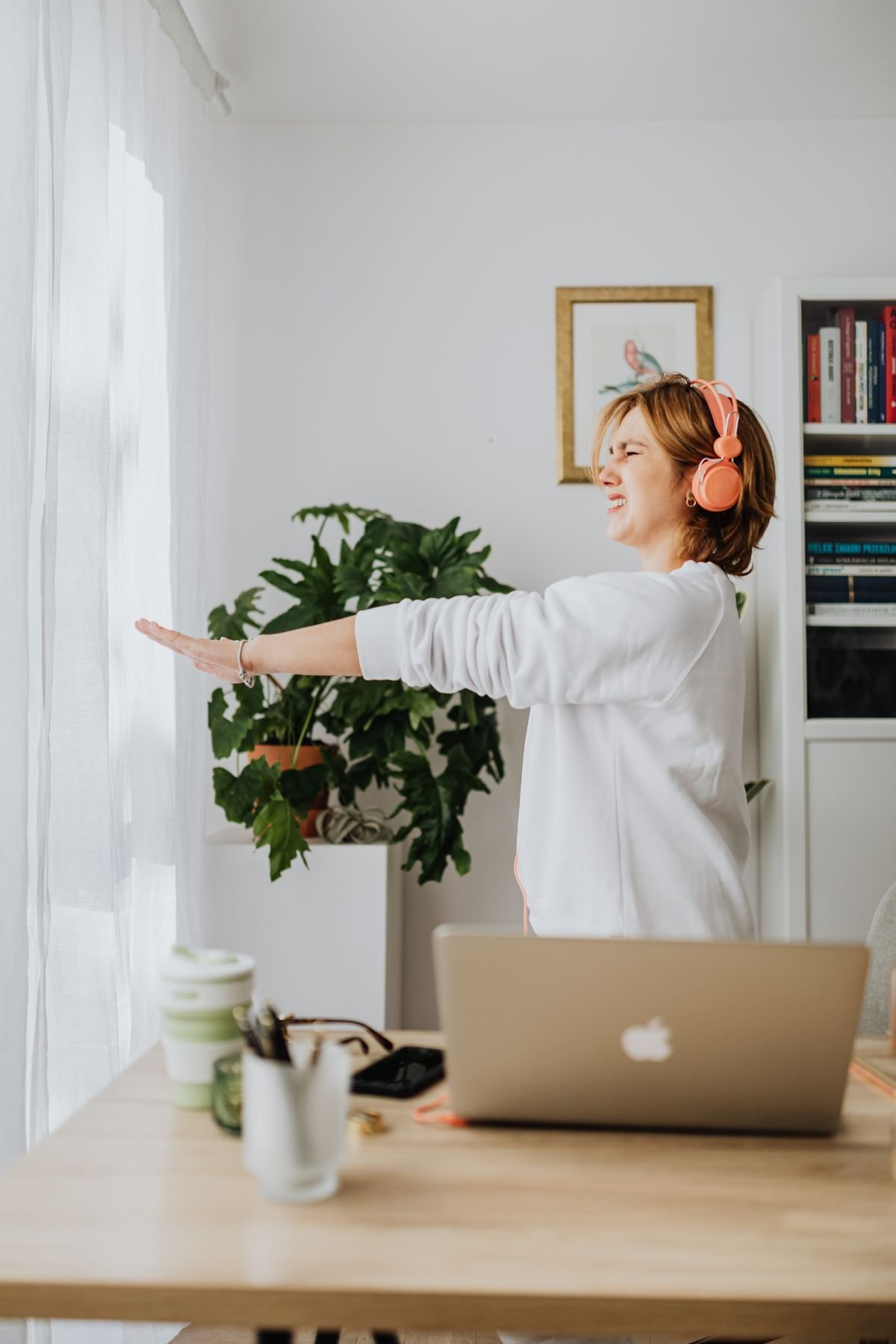

By 4pm, most desk workers are wearing their shoulders as earrings and breathing in sips. Not because they are doing anything wrong – because a chair, a screen and a deadline are a perfect recipe for a body that slowly disappears from its own awareness.
The answer is not a heroic workout after work. It is smaller and smarter: somatic snacks. Micro-movements of thirty to ninety seconds, done right at the desk, that remind your nervous system it has a body attached. If you have read our guide to somatic exercises at your desk, think of this as the grazing menu to that full meal.
Why micro works
The nervous system does not need a long intervention; it needs frequent ones. A sixty-second movement that actually involves sensing – not just stretching on autopilot – interrupts the stress accumulation cycle before it compacts into a headache or a locked jaw. Three things make a movement “somatic” rather than just fidgeting:
- Slowness. Half the speed you would naturally choose.
- Sensing. Attention inside the movement, not on the next email.
- Completion. A moment of stillness afterwards to register what changed.
The Practice: eight desk somatic micro-movements
1. The shoulder roll that actually lands (60 seconds). Raise both shoulders towards your ears on a slow inhale – really slowly, noticing the effort. Hold for two breaths. Then let them drop on a long exhale, and stay still for three breaths. The stillness afterwards is where the learning happens.
2. Jaw unhooking (45 seconds). Let your mouth hang slightly open. Move the jaw a millimetre left, then right, as if in slow-motion chewing. Finish by placing the tongue on the floor of the mouth and breathing out through the nose. Desk workers hold entire conversations in their jaw.
3. Spinal wave in the chair (90 seconds). Hands on thighs. On an inhale, let the chest roll forward and up; on the exhale, round gently back. Five slow rounds, following the movement vertebra by vertebra in your imagination. Our piece on postural awareness explains why the spine loves variety more than “good posture”.
4. Hand and forearm pour (60 seconds). Hold one hand in the other and slowly rotate the wrist, then spread the fingers wide on an inhale and soften them on the exhale. Typing hands live in permanent half-grip; this is their tea break.
5. Eye horizon (45 seconds). Look up from the screen to the furthest point available – a window, a wall, a corridor. Let the eyes rest on distance for five slow breaths. Screens collapse our visual world to arm’s length, and the nervous system reads that tunnel as pressure.
6. Seated pendulation (60 seconds). Feel your sitting bones on the chair for ten seconds. Then feel your feet on the floor for ten. Alternate three times. This is a portable version of the grounding skill from our work on restlessness in the body – it gives agitation somewhere organised to go.
7. The standing pour (90 seconds). Stand, let your knees soften, and fold forward from the hips with arms dangling. Let the head hang heavy for three breaths, then roll up slowly, stacking the spine. Do this one away from your keyboard, ideally where colleagues cannot mistake it for a system error.
8. The doorway stretch (60 seconds). Forearms on a door frame, step one foot through, let the chest open for five breaths. This undoes the inward curl that laptops teach, and it has the bonus of requiring you to leave your desk.
Building the snack habit
Willpower will not carry this; design will. Three tricks that work:
- Attach snacks to existing events. Shoulder roll after every sent proposal. Eye horizon at the top of each hour. Jaw unhooking before every video call.
- Set a quiet timer. Three gentle alarms a day beat one guilty realisation at 6pm.
- Keep score loosely. Ticked three out of eight? That is three more than yesterday. The nervous system responds to repetition, not perfection.
None of these movements will transform a life in a week. But practised across a month, they change the texture of a workday – less concrete in the shoulders, more breath in the afternoon, and a body that stays present instead of filing a complaint at 9pm.
If short practices like this speak to you, they are the everyday end of what we teach in depth at Parimukti’s somatic trainings. The same principles, scaled up, become a way of working – and for many of our students, a way of living.
FAQ
What are somatic micro-movements? Short, slow movements of thirty to ninety seconds done with full internal attention. Unlike ordinary stretching, the sensing is the point – they retrain the nervous system’s relationship with the body, not just the muscles.
How often should I do desk micro-movements? Little and often: a snack every hour or two is ideal, but even three deliberate pauses a day changes how a long workday lands in the body.
Can I do these in an open-plan office? Almost all of them are invisible to colleagues – jaw unhooking, seated pendulation, eye horizon and slow shoulder rolls read as ordinary movement. The standing pour is the only one worth saving for a quiet corner.
Do micro-movements replace exercise? No. They complement it. Exercise builds capacity; micro-movements prevent the nervous system from accumulating tension between sessions. Both matter, and neither cancels the other.
Why do my shoulders creep up again minutes after I release them? Because the creep is driven by attention and stress, not by muscle length. Each release is a rep, not a failure. Over weeks the baseline drops – the practice is cumulative.
