
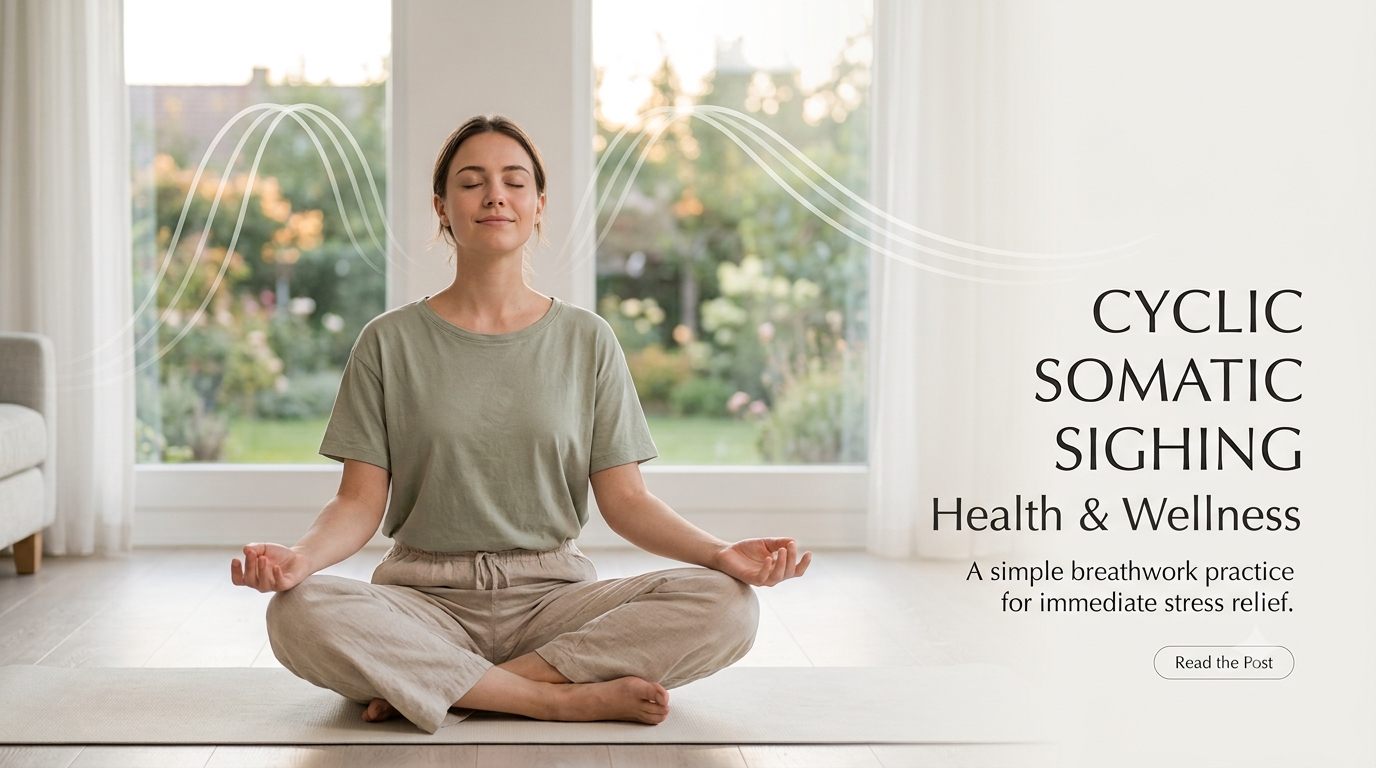

Cyclic somatic sighing
Cyclic sighing is a simple breath-based somatic exercise that combines two consecutive inhalations with a slow, extended exhalation. Sighing is also a natural physiological process that helps maintain healthy lung function. Research suggests that deliberately practising cyclic sighing may influence respiratory rate, mood, and perceived stress.
How to Practice
Find a comfortable seated or lying position. Allow the body to settle and notice your natural breathing for 30–60 seconds.
Then begin:
1. First inhale
Slowly inhale through your nose, filling the lungs comfortably. Do not force a maximum breath.
2. Second inhale
At the top of the first inhalation, take a second, smaller inhalation through the nose. Think of it as gently topping up the breath.
3. Long exhale
Slowly exhale through the mouth. Let the exhalation be relaxed, smooth and longer than the inhalation. Do not forcefully empty the lungs.
4. Repeat
Allow the next breath to arrive naturally and repeat the sequence.
Inhale → small second inhale → long exhale → natural transition → repeat.
Practice for 2–5 minutes, with 5 minutes being a practical standard duration.
The Somatic Ritual
A useful way to practice cyclic sighing is in three stages:
ARRIVE — 30–60 seconds
Don’t change the breath. Notice how you are breathing. Feel the movement of the chest, ribs and abdomen and notice any areas of tension.
REGULATE — 2–5 minutes
Begin cyclic sighing. Keep the breath comfortable and pay attention to physical sensations rather than trying to create a particular emotional experience.
INTEGRATE — 1–2 minutes
Stop deliberately controlling the breath. Return to natural breathing and observe what has changed in your body.
There is no requirement to feel calm, emotional or different. The purpose of the somatic practice is to develop the ability to notice what changes in the body when the breathing pattern changes.
What May Be Experienced
Students may notice changes in:
- breathing rate
- chest and rib movement
- abdominal movement
- muscular tension
- jaw and shoulder tension
- heartbeat awareness
- bodily temperature
- physical spaciousness or constriction
- emotional intensity
- overall sense of activation or settling
These observations are more useful than trying to interpret the experience immediately.
Why It May Work
The double inhalation increases lung inflation before the extended exhalation. Sighing has an established physiological role in maintaining lung volume.
Research on cyclic sighing has also found that regular practice can reduce respiratory rate and improve positive affect. In a randomized controlled study, participants practicing five minutes of cyclic sighing daily for one month showed improvements in positive affect and reductions in respiratory rate.
These findings support cyclic sighing as a potentially useful breath-regulation and self-regulation practice. They do not establish that cyclic sighing treats trauma, anxiety disorders or other medical conditions.
Facilitator Guidelines
Teach the exercise as an observation rather than a performance.
Useful instructions include:
“Keep the breath comfortable.”
“Make the second inhale smaller than the first.”
“Let the exhalation be long and relaxed.”
“Don’t force the breath.”
“Notice what changes rather than trying to make something happen.”
Avoid presenting the exercise as a method for “releasing stored trauma,” “resetting the vagus nerve” or producing an emotional catharsis. Those claims go beyond the evidence.
Safety
Cyclic sighing should remain comfortable. Stop and return to normal breathing if significant dizziness, breathlessness, chest discomfort, pain or distress occurs.
People with significant respiratory or cardiovascular conditions or unexplained breathing difficulties should obtain appropriate medical guidance before undertaking structured breathwork.
Student Competency
A student has learned the exercise when they can:
- Perform the first inhalation comfortably.
- Add a smaller second inhalation.
- Produce a slow, relaxed exhalation.
- Avoid deliberate breath retention.
- Repeat the pattern without excessive effort.
- Maintain awareness of bodily sensations.
- Stop or modify the practice when discomfort occurs.
- Return to natural breathing and observe the resulting changes.
Core principle:
Cyclic sighing is not about forcing the body to become calm. It is about changing the breath deliberately, observing the body’s response, and developing greater awareness of that response.
References
Balban, M. Y., et al. (2023). Brief structured respiration practices enhance mood and reduce physiological arousal. Cell Reports Medicine, 4(1).
Li, P., et al. (2022). Research on the physiological function and neural control of sighing.
