


Overwhelm has a physical signature. Attention speeds up, the chest tightens, the shoulders creep upward, and thinking tries to solve everything at once – and solves nothing. In that state, asking the mind to calm the mind rarely works. Grounding takes a different route: it gives your attention back to the body and to the room around you, and lets the rest follow.
This grounding exercise for overwhelm is a simple standing practice you can do almost anywhere: at home, at work, in a corridor before a difficult conversation. It takes about five minutes, needs no experience or equipment, and nobody watching you would know you are doing it.
What grounding actually means
In somatic work, grounding means shifting attention toward the parts of experience that are stable and present: the contact of your feet with the floor, the weight of your body, the space your body occupies in the room. When attention anchors in these steady, concrete sensations, many people find the intensity of overwhelm eases a little. Not because anything was fixed, but because the body receives current information: here is the floor, here is the room, and this moment, right now, is manageable.
Grounding is not about forcing calm. It is about giving yourself something solid to stand on while feelings move through.
The Practice
Purpose. To explore what happens when you deliberately place your attention on the contact between your body and the ground during a moment of overwhelm.
Time. About 5 minutes. Even 60 seconds is worth doing.
Position. Standing, feet about hip-width apart. If standing is not possible, sit with both feet flat on the floor.
Steps.
1. Arrive.
Stand with your feet hip-width apart and let your arms rest by your sides. You do not need a special posture. Stand the way you normally stand.
2. Rock between toes and heels.
Slowly shift your weight forward toward the balls of your feet, then back toward your heels. Do this two or three times, then let your weight settle somewhere in the middle. Notice that the floor holds you up without you having to do anything.
3. Map your base.
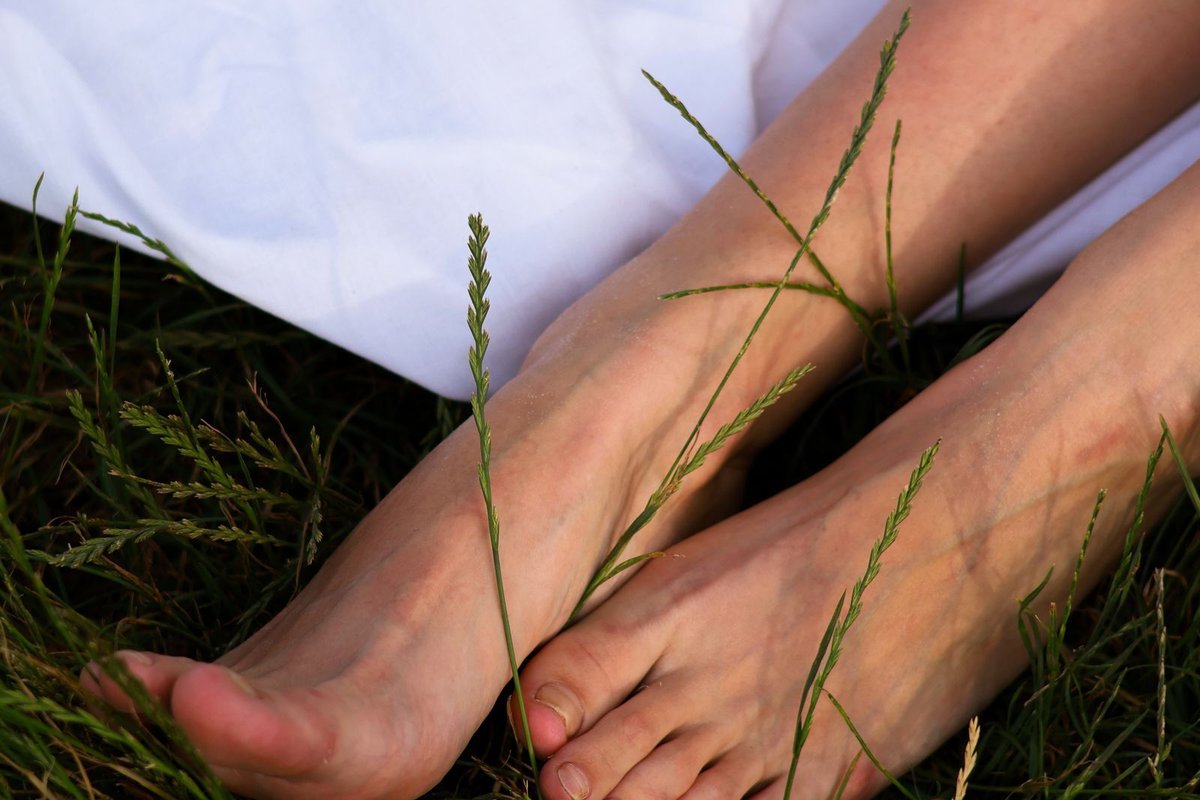
Bring your attention to the actual points of contact: the ball of each foot, the outer edges, the heels. If it helps, gently curl your toes once or twice and let them spread again. Feel the texture of the floor or your socks.
4. Let your eyes help.
Keep the feeling in your feet and slowly look around the room. Let your gaze travel to the walls, the ceiling, the door. Silently name a few things you can see. Grounding through the feet and orienting through the eyes work well together: one tells the body it is supported, the other tells it where it is.
5. Lengthen the exhale slightly.
Take one or two breaths where the out-breath runs a little longer than usual, as if breathing out through a straw. Do not take a big in-breath first. Just let the exhale soften and slow, then let the breath return to normal.
6. Stay for a moment.
Stand quietly for another half a minute. Notice what, if anything, has changed.
What to notice
People report all kinds of things after this practice, and none of them is the correct answer. You might notice warmth or tingling in your feet, a clearer sense of your own weight, your breath slowing on its own, or your shoulders dropping a few millimetres. You might notice tiredness that was hiding underneath the busyness. You might notice nothing much at all. All of that is normal. The skill you are building is noticing itself, not producing a particular sensation.
If it feels too much
For some people, bringing attention into the body initially makes discomfort louder, not quieter. If that happens, you have options. Keep your eyes open and let them move around the room. Press your feet more firmly into the floor. Shorten the practice to thirty seconds. Or stop altogether and do something ordinary: make tea, step outside, run your hands under water. The exercise is meant to be a resource, not an endurance test.
Common mistakes
Trying to relax. This is not a relaxation competition. The task is only to feel your feet and look around the room. Settling, when it comes, is a side effect rather than an assignment.
Making the breath big. Taking deep breaths can leave some people light-headed and more activated. Keep the breath ordinary and only lengthen the exhale slightly.
Rushing the weight shifts. Moving slowly is what gives your attention time to actually arrive in your feet. Two slow shifts beat ten quick ones.
Saving it for emergencies. The practice is much easier to find in a hard moment if you have rehearsed it on ordinary days. A week of short, unremarkable repetitions is what makes it available when you need it.
How long, and how often
Five minutes is a practical standard. One minute still counts. Many people practise once a day for a week – after waking, or when they come through the door in the evening – and then keep the exercise in their pocket for specific moments: before a presentation, after difficult news, standing in a queue that is testing their patience.
When to stop or adapt
Stop, or switch to the seated version, if you feel dizzy, panicky, or more overwhelmed rather than less. Keeping your eyes open and your attention on the room usually helps. And a word of proportion: if overwhelm is frequent, intense, or frightening for you, that deserves more support than a self-practice can offer. Working with a qualified somatic practitioner, or a mental-health professional, gives you a container that an exercise done alone cannot.
A short integration
After practising, take thirty seconds to note – in your head or on paper – two things: where in your feet you feel the ground most easily, and what changed, if anything. This small act of remembering matters. The next time overwhelm arrives, you are not learning a new exercise; you are returning to a familiar one.
Where to go from here
Grounding is one of the first skills taught in somatic work because so much else builds on it. If you would like a wider set of practices in the same spirit, our overview of somatic exercises for stress and anxiety relief is a good next read.
And if you notice a pull not just to use these practices but to guide others through them, that is exactly what professional somatic training is for. In the Parimukti somatic facilitator training in Goa, grounding is taught as a core professional skill – practised daily, and learned well enough to hold space for someone else’s overwhelm, not only your own.
FAQ
Is grounding the same as mindfulness?
They overlap, but grounding is deliberately body- and environment-based, and usually brief. Rather than observing whatever arises, you are actively placing attention on contact, weight and surroundings – which many people find easier when the mind is racing.
Can I do it sitting down?
Yes. Sit with both feet flat on the floor and follow the same steps. Pressing the feet down works just as well from a chair.
What if I feel nothing?
Noticing “nothing” is already noticing. Try the toe curl, slow the weight shifts down, and give it a week of short repetitions before you judge it. For most people the sensation is quiet rather than dramatic, and quiet is the point.
